notes
this JPEG image
previous
index
next
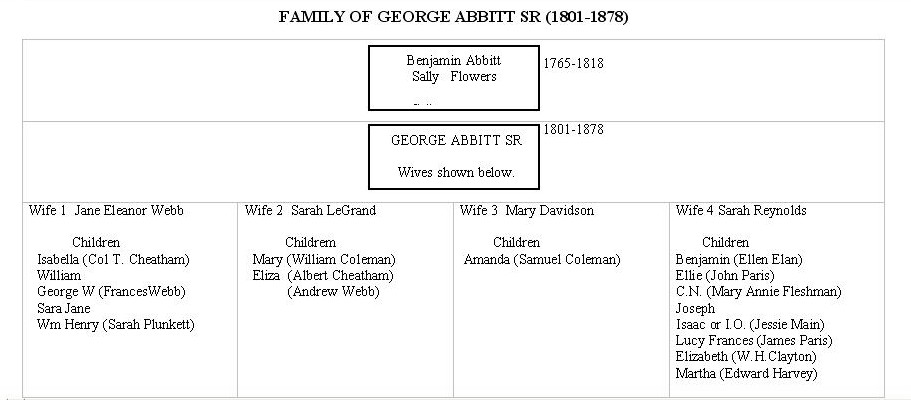
This chart information was gathered from an Article by Watkins M Abbitt Jr in a book by the Appomattox Heritage Committee 2001 and from family memories and pictures. Where possible names were checked .with History of Appomattox by N. R. Featherston 1948 printing.
GUIDE; The chart shows George Abbitt Sr married 4 times and with 16 children. The 4 wives are shown horizontally in time sequence, Their children are shown underneath in the wife's column, the oldest first, etc. Spouses are shown in parenthesis For example, the first wife Jane Eleanor Webb's, 3rd child was Col. George W. Abbitt, famous for his Cival War record, and married to Frances Webb.
George Abbitt Sr was a much admired and wealthy plantation owner. Gayle Williams who researched the history of Redfields (name given to the homestead of Mr. Abbitt), points out that he bought 2000 acres in Prince Edwards County (later Appomattox County) in the Piedmont Section of Virginia the same year he married Eleanor Webb- 1824 A spacious 3 story house was built during the next 6 years The property was turned into a large plantation. An 1845 census reported the value of the plantation at $15230 with 33 slaves. Before the railway came to Appomattox in 1861 it was necessary for a plantation to do many operations more that a present farm does. Cotton, corn, wheat, wool ,all types of fruit and vegetables were grown, harvested. and preserved. In wheat for example, in addition to planting and harvesting the crop, a thrashing facility and flour mill were needed. Cotton was converted locally to make socks, gloves, and candle sticks. The need was to be self sufficient
An Abbitt son by the 4th wife, I.O. (Isaac) Abbitt , in his Ninety Years of Historical Facts, records many activities in his youth at Redfields. He speaks of an occasion in 1865 as the Union Army was advancing to head off General Lee at Appomattox that General Custer recued Mrs Abbitt fom a drunken Union Soldier who had threatened to burn the house. .Later,General Sheridan confiscated part of the house and acreage for his headquarters and a temporary hospital. The entire acreage was in between the Union Army and General Lee's Army. So it became available for theft by the discharged and pardoned solders as they returned to their homes after the surrender. Much of the stock, food and equipment was stolen. Before the time of the Civil War the Abbitt property consisted of these 2000 acres, 500 more southeast of these, 100 acres in Campbell County, 33 slaves, 30 horses, 80 sheep, several hogs and much up-to-date equipment needed for farming
George Abbitt Sr died in 1878, leaving a large estate as mentioned above. He left a debt of only $200. His wife of 20 years, Sarah Reynolds Abbitt, was then 43 years of age, and was named Administrator. But the future of Mrs Abbitt would not be easy. Besides being the manager of this large operation, plus the task of care and feeding of 8 children, a new disaster was to strike. According to I.O. Abbitt's history "With the small liability, she, thinking that was all of his indebtedness, did not claim the widow's dower by law" Later, it was revealed that her husband had signed as security on notes of his son by a former marriage. This resulted in the sale of all of the best land, the home , furniture and livestock. By some clever means she was able to buy back the home and 200 acres and maintain residence. Mrs Abbitt had done a notable job. The family remained in residence until 1971 (except for a short time in Crewe). It was sold then, and is presently (2005) owned by TBD
4/06/05 CWA/CS